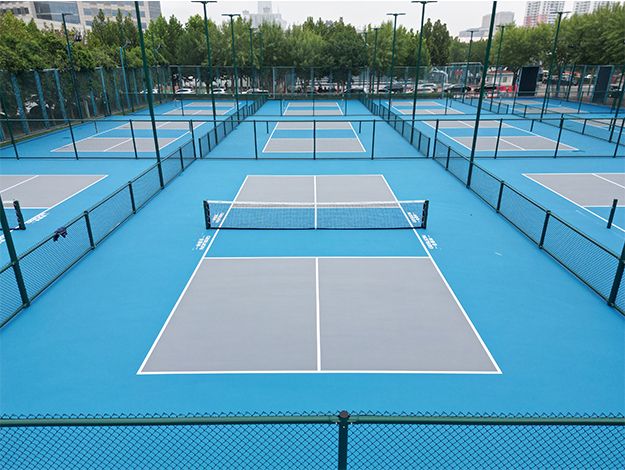
A tennis court can be one of the most useful shared amenities in a residential community. It gives residents a convenient place to exercise, encourages social interaction, and provides an outdoor activity that can be enjoyed by different age groups. However, simply building a hard surface and installing a net does not guarantee that the court will be safe, comfortable, or easy to maintain.
Residential tennis courts face challenges that are less common in professional stadiums. They are often located close to homes, gardens, parking areas, swimming pools, or pedestrian paths. They may be used by children, beginners, experienced players, and older residents. Some communities also want the same space to support pickleball or other recreational activities.
Effective tennis court solutions for residential communities must therefore balance playing performance with drainage, lighting, noise control, safety, accessibility, appearance, and long-term maintenance.

Understanding How the Court Will Be Used
The first step in planning a community tennis court is understanding who will use it and how frequently it will be used.
A court designed for casual weekend play may have different requirements from one used for daily coaching, community competitions, or organized leagues. A large residential development may need more than one court, while a smaller community may benefit from a flexible court that supports several activities.
Before construction or renovation begins, communities should consider several questions:
◆ How many residents are likely to use the court?
◆ Will players need to reserve time?
◆ Will tennis lessons or organized events be permitted?
◆ Will the court be used after sunset?
◆ Should the court accommodate pickleball?
◆ Are there children or older residents who need additional safety or comfort features?
◆ Who will inspect and maintain the facility?
These questions affect almost every later decision, including surface type, lighting, fencing, seating, storage, and operating rules.
Selecting the Right Location
The location of a residential tennis court influences both player experience and the comfort of nearby residents.
A standard tennis court is 23.77 meters long. It is 8.23 meters wide for singles and 10.97 meters wide for doubles. These measurements cover only the marked playing area. Additional space is required behind the baselines and beside the sidelines so players can move safely.
The total site must also provide room for fencing, gates, light poles, seating, drainage, landscaping, and maintenance access.
Where possible, courts are commonly positioned approximately north to south. This can help reduce problems caused by low morning and evening sunlight shining directly into players’ eyes. However, orientation may also be affected by the shape of the site, nearby buildings, prevailing winds, existing trees, roads, and underground utilities.
Distance from surrounding homes is another important factor. Placing the court too close to bedrooms, patios, or quiet garden areas may increase concerns about ball impacts, player voices, lighting, and evening activity. Landscape buffers and thoughtful court placement can help reduce these effects.
Why Drainage Is Essential
Water is one of the biggest threats to an outdoor tennis court. Poor drainage can cause standing water, slippery areas, surface discoloration, coating deterioration, and damage to the foundation.
The finished court should have a slight and consistent slope that directs water away from the playing surface. Low areas, sometimes called birdbaths, can hold water after rain and make part of the court unusable.
Drainage planning should also consider water coming from outside the court. Roof downspouts, irrigation systems, slopes, gardens, and nearby paved areas can all direct water toward the facility.
In colder climates, water beneath the court may freeze and expand, contributing to cracks or movement in the base. In warm and humid regions, persistent moisture can encourage mold, algae, and surface contamination.
A new court should therefore be designed with suitable grading, a stable foundation, and a clear route for water to leave the site. On an existing court, repeated puddling may indicate that resurfacing alone will not solve the underlying problem.
Choosing a Tennis Court Surface
The surface affects ball speed, bounce, player movement, comfort, appearance, and maintenance. There is no single surface that is ideal for every residential community.
Standard Acrylic Hard Courts
Acrylic surfaces are widely used for outdoor community tennis courts. The coating is normally applied over an asphalt or concrete foundation.
A properly installed acrylic system can provide consistent ball bounce, reliable traction, and clear line visibility. It is also available in different colors, allowing the court to complement surrounding buildings or landscaping.
Routine maintenance usually involves cleaning the surface, removing debris, monitoring cracks, and repairing damaged areas before they spread.
Cushioned Acrylic Courts
Cushioned acrylic systems include resilient layers beneath the final playing surface. These layers create a softer feel underfoot and can make extended play more comfortable.
This option may be useful in communities with frequent players, older residents, or users who prefer additional shock absorption. However, a cushioned system cannot correct an unstable foundation. The base and drainage must still be properly constructed.
Clay Courts
Clay produces a slower playing experience and allows controlled sliding. It can be comfortable for players, but it generally requires more regular care than an acrylic court.
Watering, brushing, line cleaning, and surface leveling may be necessary to keep a clay court in suitable condition. A residential community should consider whether it has the staff, equipment, and water supply required for this level of maintenance.
Synthetic Grass Courts
Synthetic grass may be selected for its appearance or recreational playing characteristics. Its performance depends on the type of fiber, infill, foundation, and drainage system.
Communities considering synthetic grass should evaluate ball bounce, traction, heat, infill movement, cleaning requirements, and long-term replacement needs.
Tennis Court Fencing and Ball Control
Fencing keeps balls inside the playing area and separates the court from roads, gardens, playgrounds, swimming pools, and pedestrian spaces.
The fencing behind the baselines is often higher because balls are more likely to leave the court in those areas. Side fencing may sometimes be lower, depending on the site and intended level of play.
A safe fencing system should have:
◆ Suitable mesh openings for ball containment
◆ Stable posts and foundations
◆ Corrosion-resistant materials
◆ Smooth surfaces without exposed sharp edges
◆ Secure gates
◆ Adequate access for players and maintenance equipment
◆ Sufficient visibility around the court
Fence color can also affect the playing experience. Darker mesh is often less visually distracting because players can see the ball and surrounding area more clearly through it.
Windscreens can provide privacy and reduce visual distractions. They may also offer limited protection from wind. However, a windscreen increases the wind load placed on the fence, so the supporting structure must be strong enough for local weather conditions.
Lighting Without Disturbing Nearby Homes
Lighting allows residents to use the court during the evening, but it must be carefully controlled in a residential environment.
Good tennis court lighting is not simply a matter of installing brighter fixtures. Players need consistent illumination across the entire playing surface. Large differences between bright and dark areas can make it difficult to follow the ball, especially during serves and overhead shots.
An effective lighting design should consider:
◆ Light distribution and uniformity
◆ Fixture position and mounting height
◆ Glare experienced by players
◆ Light spill outside the court
◆ Nearby windows and outdoor living spaces
◆ Shadows from trees, fences, or buildings
◆ Energy use and operating controls
LED sports lighting is commonly used because it offers instant operation and more precise beam control than many older systems. Even so, fixtures should be selected and positioned according to a photometric lighting plan.
Timers and automatic shutoff controls can prevent the lights from remaining on after the court has closed. Clear operating hours are also important for maintaining a reasonable balance between evening recreation and residential comfort.
Managing Noise Around Community Courts
Tennis creates sound through racket impacts, bouncing balls, player communication, gates, and surrounding activity. Although these sounds are normal, they may become noticeable when a court is located close to homes.
Noise concerns can be reduced by increasing the distance between the court and residential buildings, using landscaped buffer areas, installing gates that do not slam, and limiting play during early mornings or late evenings.
Seating areas should also be positioned carefully because conversations and group activities may create more continuous noise than play itself.
Communities planning to add pickleball should conduct a separate noise review. Pickleball uses different balls and paddles, producing a sharper sound than conventional tennis. Adding pickleball lines without considering court location and operating hours may create unexpected complaints.
Making the Court Accessible and Comfortable
Residential community courts should be suitable for a wide range of users. The route from parking areas or community paths to the court should be stable, level, and easy to navigate.
Gates should provide sufficient clearance, and abrupt changes in level should be avoided. Seating areas can include open spaces beside benches for wheelchair users or people with mobility equipment.
Other practical features include:
◆ Player benches
◆ Shade structures
◆ Drinking-water access
◆ Equipment storage
◆ Waste bins
◆ Clear court rules
◆ Hooks or shelves for personal belongings
◆ Squeegees for removing water
◆ Emergency contact information
These features do not change the dimensions of the playing area, but they can significantly improve the daily experience of residents.
Should a Residential Tennis Court Be Multi-Use?
Converting a tennis court into a multi-use sports area can increase participation, particularly where space is limited. Pickleball is the most common addition, but some communities also consider basketball, badminton, or general fitness activities.
Multi-use courts have clear advantages, but they require careful planning. Too many line markings can confuse players, and different sports may need different nets, post locations, and safety clearances.
If multiple sports will share the court, secondary lines should use colors that are clearly different from the primary tennis markings. Portable equipment should be stable during use and stored safely when not required.
Communities should also create scheduling rules to prevent conflicts between tennis players and other users. It is usually easier to plan these features during original construction than to drill new sockets or modify the fencing later.
Maintaining a Residential Tennis Court
Regular maintenance helps preserve court appearance and prevents small defects from becoming larger problems.
Leaves, soil, food, standing water, and organic material should be removed promptly. Drains and channels should remain clear, while nearby plants should be trimmed before roots or branches affect the court.
The surface should be inspected periodically for:
◆ Cracks
◆ Peeling coatings
◆ Faded lines
◆ Low areas
◆ Mold or algae
◆ Changes in traction
◆ Uneven settlement
Nets, posts, fences, gates, windscreens, benches, and lights should also be checked. Loose fence fittings or damaged net hardware can become safety hazards if they are ignored.
Harsh chemicals and aggressive pressure washing may damage some sports surfaces. Cleaning methods should always be suitable for the installed coating.
Resurfacing Versus Reconstruction
Color fading and light surface wear can often be corrected through resurfacing. This normally includes cleaning, minor repairs, preparation, new coating layers, and fresh line marking.
Structural cracks, serious settlement, or repeated drainage problems require more investigation. Applying new color over an unstable base may improve appearance temporarily, but the damage is likely to return.
Reconstruction may be necessary when the foundation has moved, the slope is incorrect, or large sections of the court no longer drain properly. A professional inspection can help determine whether the problem is cosmetic or structural.
Common Mistakes to Avoid
Some of the most common residential tennis court problems result from decisions made before construction. These include:
◆ Selecting a site without studying drainage
◆ Providing too little space outside the playing lines
◆ Placing the court too close to homes
◆ Choosing lighting fixtures without checking glare or light spill
◆ Attaching windscreens to fencing that cannot support the added wind load
◆ Applying a new surface over active structural cracks
◆ Adding multiple sports without considering noise and scheduling
◆ Failing to establish a maintenance plan
Addressing these issues during planning is usually easier than correcting them after the court is in use.
Conclusion
A successful residential community tennis court is more than a playing surface. It is a combination of site planning, drainage, flooring, fencing, lighting, equipment, accessibility, and maintenance.
The most appropriate solution depends on the local climate, number of users, available space, surrounding homes, expected level of play, and ability of the community to maintain the facility. When these factors are considered together, a tennis court can remain safe, attractive, and enjoyable for many years.
For communities reviewing the components involved in a new court or renovation, UHS provides related tennis court products, including acrylic sports flooring, court fencing, LED lighting, tennis nets, posts, benches, and supporting court equipment.